
What is each extra day per claim costing your shop?
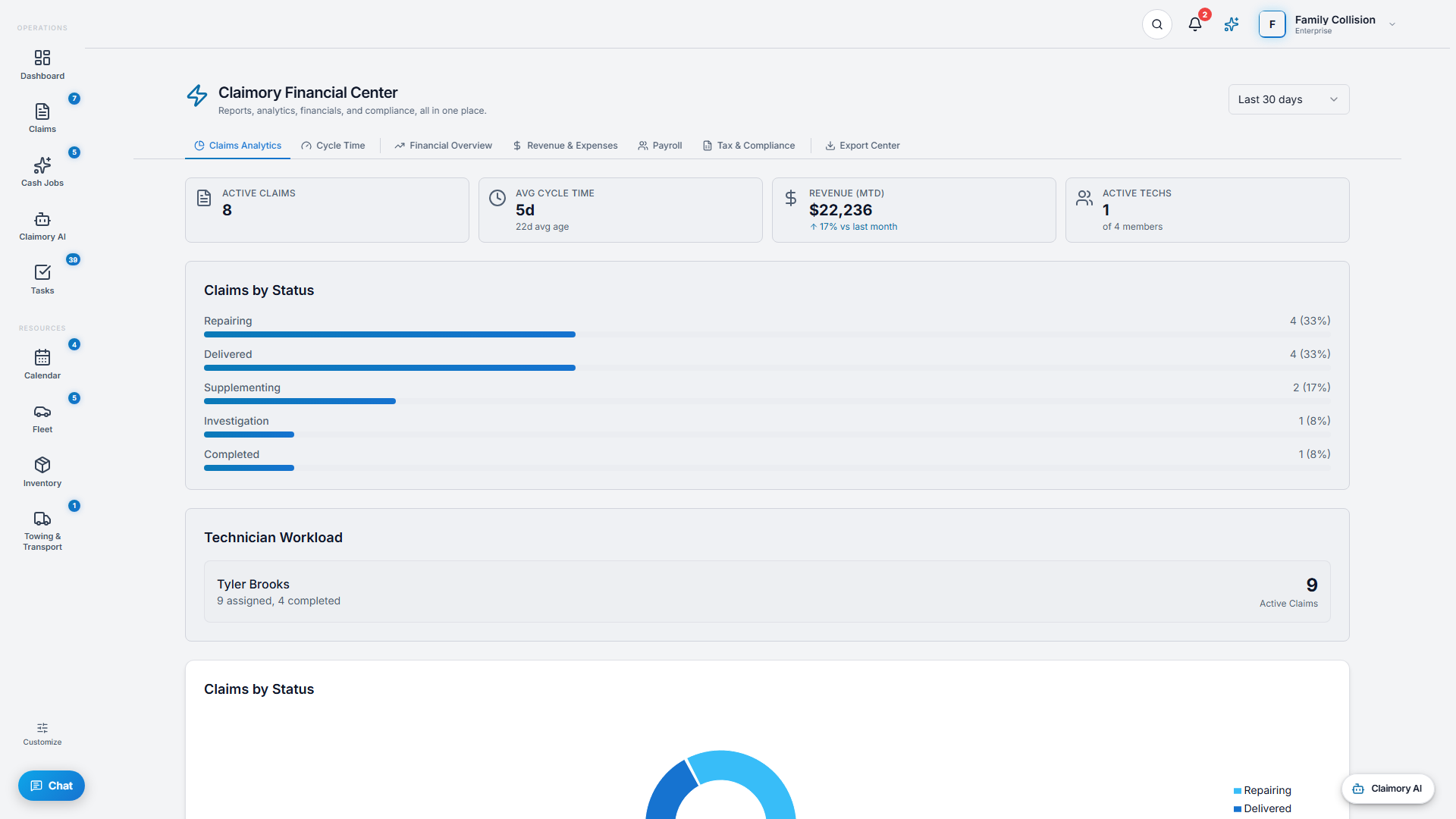
How much is cycle time costing your body shop? Enter your claims per month, the days you could save per claim, your per-day carrying cost and your average estimate, and this free calculator gives your own yearly dollar number from those inputs. This free calculator comes from Claimory, the all-in-one body shop management software for collision repair shops, and the Claimory Cycle Time report measures your real cycle time: average days from job start to finish on Completed and Delivered claims.
Your shop's numbers
Total insurance claims processed in a typical month.
Realistic reduction with better workflow. The model's range is 1 to 3 days.
Rental exposure plus soft cost. The model's range is $35 to $90.
Used to size the throughput uplift. The model's range is $2,400 to $4,500.
Annual cycle-time recovery
$32,400
direct rental + soft-cost recovery
Throughput uplift assumes the bay-time freed by faster cycle gets refilled with new claims (capped at 50% of baseline). See the full methodology.
Want to recover $248,400 a year?
Claimory shortens cycle time with adjuster-reply drafts, supplement aging, and a customer portal that kills "where is my car" calls. 14-day free trial, no credit card.
Where the days actually disappear
Most collision shops do not lose cycle days to slow technicians. They lose days to wait windows. Adjuster sitting on an approval. Customer not responding to a deductible question. Parts ordered against a stale estimate that needs supplementing. Each wait is a day the bay does not turn.
The biggest single lever is shrinking the wait windows: a clean adjuster email thread per claim, customer portal updates that reduce phone tag, and supplement aging that flags claims before the carrier window closes. How much cycle time a shop can actually recover varies; the recovery methodology shows how we model the reduction and the assumptions behind it.
Measure your real cycle time in Claimory
This calculator runs on a guess at the days you could save. The Cycle Time tab in the Claimory Financial Center replaces the guess with your shop's own number: the average days from job start to Completed or Delivered across your finished claims, with open claims, total losses and impossible dates left out.
The same tab shows the typical days between each pair of your repair steps, so you can see whether cars wait on teardown, supplement approval or parts, and lists the eight open claims that have been in the shop longest.
Cycle time calculator questions
How does the cycle time calculator work out the yearly recovery?
The Claimory cycle time calculator multiplies claims per month, times days saved per claim, times the per-day carrying cost of a vehicle (rental exposure plus soft cost). That is the monthly recovery; times 12 is the yearly recovery. With 25 claims, 1.8 days and $60 a day, that is $2,700 a month and $32,400 a year.
How is the throughput uplift computed?
Throughput uplift assumes the bay time a faster cycle frees gets refilled with new claims. The calculator works it out as claims per month, times 12, times days saved divided by a 7-day baseline cycle, times the average estimate, with the share capped at 50% of baseline volume.
Is the cycle time recovery a guarantee?
No. The result is a model built from your inputs. Real shops vary by carrier mix, DRP work, severity, technician capacity and existing process, so measure your own cycle time before and after a change.
How does Claimory measure a shop's real cycle time?
Cycle time in Claimory is the number of days from the day a repair job started to the day it reached Completed or Delivered. The start is the start date the shop set on the claim, or the day the claim was opened in Claimory when no start date was set. The Cycle Time tab averages it across the shop's own finished claims, leaving out open claims, total losses and claims with impossible dates.
Shrink the wait windows in 14 days
Free trial, no credit card. The trial uses your real claims so you can measure the cycle-time delta on your own data.
No credit card. Works with CCC ONE and Mitchell.